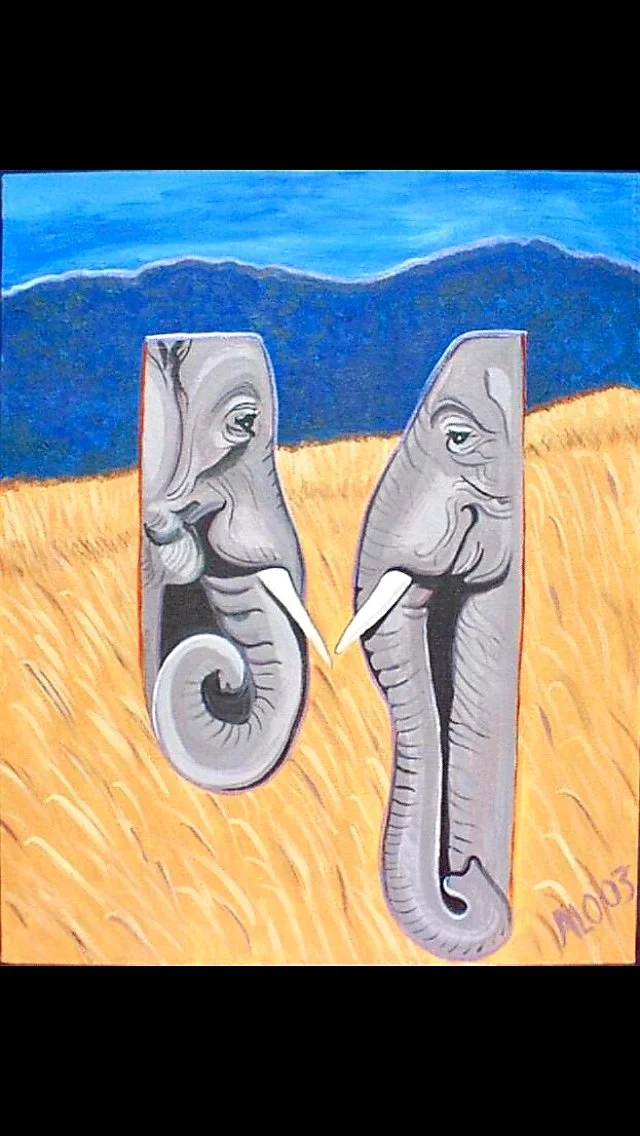
“Grains of Memory” © 2026 by Anlon O’Brien
In an ancient story from the Indian subcontinent used in multiple faiths, six blind men encounter an elephant. Each man touches a different part of the large animal, which leads to conflicting descriptions:
The one who touches the ear believes the elephant resembles a fan.
The one who touches the trunk believes it is like a serpent.
The one who touches the tusk thinks he’s feeling a spear.
The one who touches the side feels it is akin to a wall.
The one who touches the leg believes the elephant resembles a pillar.
The one who touches the tail believes it’s certainly a rope.
Each man vehemently argues that his description is the correct one, and in some versions of the story the disagreement even results in fisticuffs.
The commonly held moral is that while each man is right in part, they are all wrong in entirety due to lacking a comprehensive view of the whole elephant. This fable may illustrate perspective, foster tolerance or indicate that conflicting viewpoints can hold fragments of a larger truth.
The Bible discourages us from bearing false witness in both the Old Testament and the New. But who is the False Witness in the above story? And which of those witnesses holds the truth? In Romans 8:16, Apostle Paul said that "The Spirit himself bears witness with our spirit that we are children of God."
The Divine Spirit is the only witness capable of perceiving the entire fabric of creation, so It is the only being capable of knowing the Truth, that we are children of God. Each of us, in our humble capacity as “Jordan Smith” or “Lindsey James” can see but a single thread of the tapestry…or perhaps only one lone knot within that thread. In a human wall hanging, we are talking about 1/50,000th of the composition. But considering the Infinite loom of creation, that knot is infinitesimal. It represents the pitfalls of arrogantly clinging to restricted assessments, or projecting them onto a neighbor. How could one ensnarled thread purport to exemplify the vast freedom of Infinite Spirit? How could the blind guy, believing the elephant is a serpent because he laid hold of the trunk, possibly hope to convey any grander reality?
Our five physical senses bring on our blindness. They function as reductive valves allowing illusory separation to appear real. A pressure-reducing valve is an automatic device decreasing high incoming fluid pressure to a lower, constant, downstream force, regardless of fluctuations in supply or flow. While this proves handy in managing water supply systems, it also diminishes the vast oneness of Niagara to a steady drip barely filling your tiny tub. It contains elements of the whole, but they are restricted to allow you the experience of “my bath.”
The only True Witness is the silent witness, the one we find when completely averting from the fiction of the five senses to abide in “I AM.” The True Witness dwells there in union, but the moment we tack any descriptor onto “I AM” -whether it’s “I am beautiful” “I am ugly” or “I am Mary” - we’ve attached limitations to Infinite form, thus rendering our testimony entirely false.
Reliance upon the truth of any sense…eyesight, hearing, smell…is misguided. Each is subjective. One cannot precisely duplicate personal experience. No two witnesses in any audience possess identical perceptive abilities, nor are they situated at the same vantage point. So, when any blind man grasps a part of the elephant then staunchly persists in his imperfect understanding, he becomes the False Witness...even as he firmly clutches his mistaken “truth.”
The False Witness punishes himself through his own misunderstanding, just as the blind guy who believes the elephant a rope punishes himself when he yanks it. Any half-truth is a lie; behold the whole truth within, dear traveler.
Sources:
Parable of Blind Men and the Elephant, multiple interfaith sources, Indian sub-continent.
Matthew 19:18 KJV “He saith unto him, Which? Jesus said, Thou shalt do no murder, Thou shalt not commit adultery, Thou shalt not steal, Thou shalt not bear false witness…”
Exodus 20:16, KJV (Ninth Commandment) “Thou shalt not bear false witness against thy neighbor.” (Widely considered to prevent lying in a legal or social context, specifically false testimony to harm a neighbor’s reputation, liberty or property. “False witness” was a legal term in ancient Israel, so interpreters consider defamation, slander and perjury as the implied applications of this commandment. Limiting biblical interpretation to legal or social implication seems shortsighted when regarding a sacred book of mysteries layered with rich allegory.)
Proverbs 19:5 KJV "A false witness shall not be unpunished, and he who speaketh lies shall not escape."